How Net Billing Works in Alberta
Under Alberta net billing, electricity you export is credited at the same retail rate you pay for electricity you import. On dedicated retailer solar rates, that credit is up to $0.35/kWh as of 2026. Credits are dollars on your bill, so they offset delivery and transmission charges too, and unused credits bank from sunny months into winter.
Every grid-tied solar system in Alberta operates under the province's Micro-Generation Regulation, and the way you get paid is called net billing. It is the single most misunderstood part of going solar here, partly because most of the internet explains Ontario or California rules instead. This guide covers exactly how it works in Alberta, with a worked bill example. Last updated July 2026.
What rate do I get paid for exported solar power?
Your retail rate. The price your retailer charges you per kWh is the price they credit you per kWh exported. If you pay 12 cents, you earn 12 cents. If you are on a dedicated solar rate at 35 cents through the sunny months, you earn 35 cents. There is no separate wholesale "sell-back" price for residential solar in Alberta, and anyone modelling your payback on one is underselling your system.
The often-quoted $0.35/kWh figure is a retailer solar rate available province-wide, not a government subsidy: several Alberta retailers offer high-credit solar plans, and switching retailers is straightforward. Pairing a high solar rate for April through September with a low-cost plan for winter is a standard optimization we walk every client through.
Is net billing the same as net metering?
Not mechanically, but in Alberta the result is equivalent. Net metering (Ontario, most of the US) spins one meter reading backward and forward and bills the net kWh. Net billing measures imports and exports separately and prices each on your bill. Since Alberta prices both directions at the same retail rate, the math lands in the same place: you are never selling low and buying high.
What does net billing look like on a real bill?
A typical July for a Calgary home with a 10 kW system:
| Line item | Amount |
|---|---|
| Grid imports: 350 kWh × $0.35 | $122.50 |
| Delivery, transmission, riders, admin | $95.00 |
| Solar exports: 900 kWh × $0.35 | -$315.00 |
| Bill total | -$97.50 (credit banks forward) |
Illustrative July bill: 1,250 kWh produced, 350 kWh imported (nights, cloudy days), 900 kWh exported. Actual numbers depend on your system, usage, and rate plan.
The important detail is the last line: the export credit wiped out not just the energy charge but the delivery and transmission charges too, and the leftover $97.50 carries to August. Roughly 60% of an Alberta bill is non-energy charges that most people assume are untouchable. Under net billing they are not.
What happens in winter?
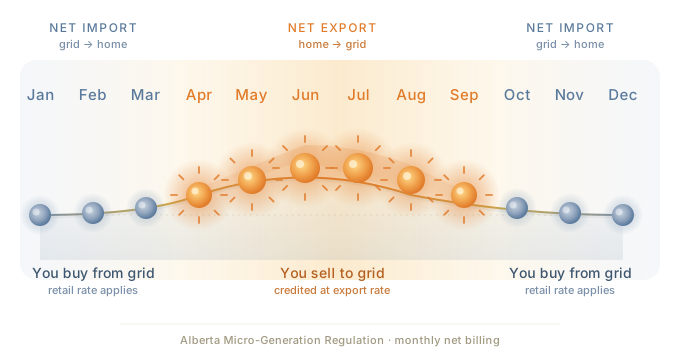
Alberta solar is a seasonal trade. From April through September a properly sized system over-produces and banks credits; from October through March you draw from the grid and spend them. Over a full year, a system sized to your consumption can offset 80 to 100 percent of your electricity cost. Cold improves panel efficiency, and snow slides off south-facing panels within a day or two, so winter production is lower but not zero. More on the physics in how solar works in Alberta.
How big can my system be?
The Micro-Generation Regulation covers systems up to 5 MW (residential falls under the Small category, up to 150 kW), but the practical limit is your own annual consumption: microgeneration systems are sized to offset your usage, and Flux designs to roughly 105% of your annual kWh. Your inverter backfeed also has to fit your electrical panel under the CEC 125% busbar rule, which is a design constraint we engineer around, not a surprise you discover at inspection.
Frequently asked questions
What rate do I get paid for solar exports in Alberta?+
Your retail electricity rate. Under Alberta net billing, the price you pay per kWh imported is the price you are credited per kWh exported. Retailers with dedicated solar rates credit exports at up to $0.35/kWh as of 2026. There is no separate, lower "sell-back" rate in Alberta.
Is net billing the same as net metering?+
The mechanics differ but the economics are equivalent in Alberta. Net metering nets kWh on one meter reading; net billing prices imports and exports separately on your bill. Because both directions are priced at the same retail rate, you never sell low and buy high.
Do export credits cover delivery and transmission charges?+
Yes. Export credits are dollar credits on your bill, so they offset the whole bill: energy, delivery, transmission, rate riders, and admin fees. Roughly 60% of a typical Alberta electricity bill is non-energy charges, and credits apply against those too.
What happens to my net billing credits in winter?+
Credits bank on your account. A properly sized Alberta system over-produces from April through September, building a credit balance that draws down through the darker months of October through March. Many Flux clients see near-zero bills across the summer and reduced bills in winter.
Is there a limit on how big my solar system can be?+
Alberta's Micro-Generation Regulation covers systems up to 5 MW, but for a home the practical cap is your annual consumption: a microgeneration system is sized to offset your own usage (Flux designs to roughly 105% of your annual kWh), and your utility interconnection is approved on that basis.
Key takeaways
- Exports are credited at your retail rate; imports and exports are priced the same
- Dedicated retailer solar rates credit up to $0.35/kWh as of 2026
- Credits are dollars, so they offset delivery and transmission charges too
- Summer surplus banks forward to cover winter bills
- Systems are sized to your consumption (about 105% of annual kWh) under microgeneration rules