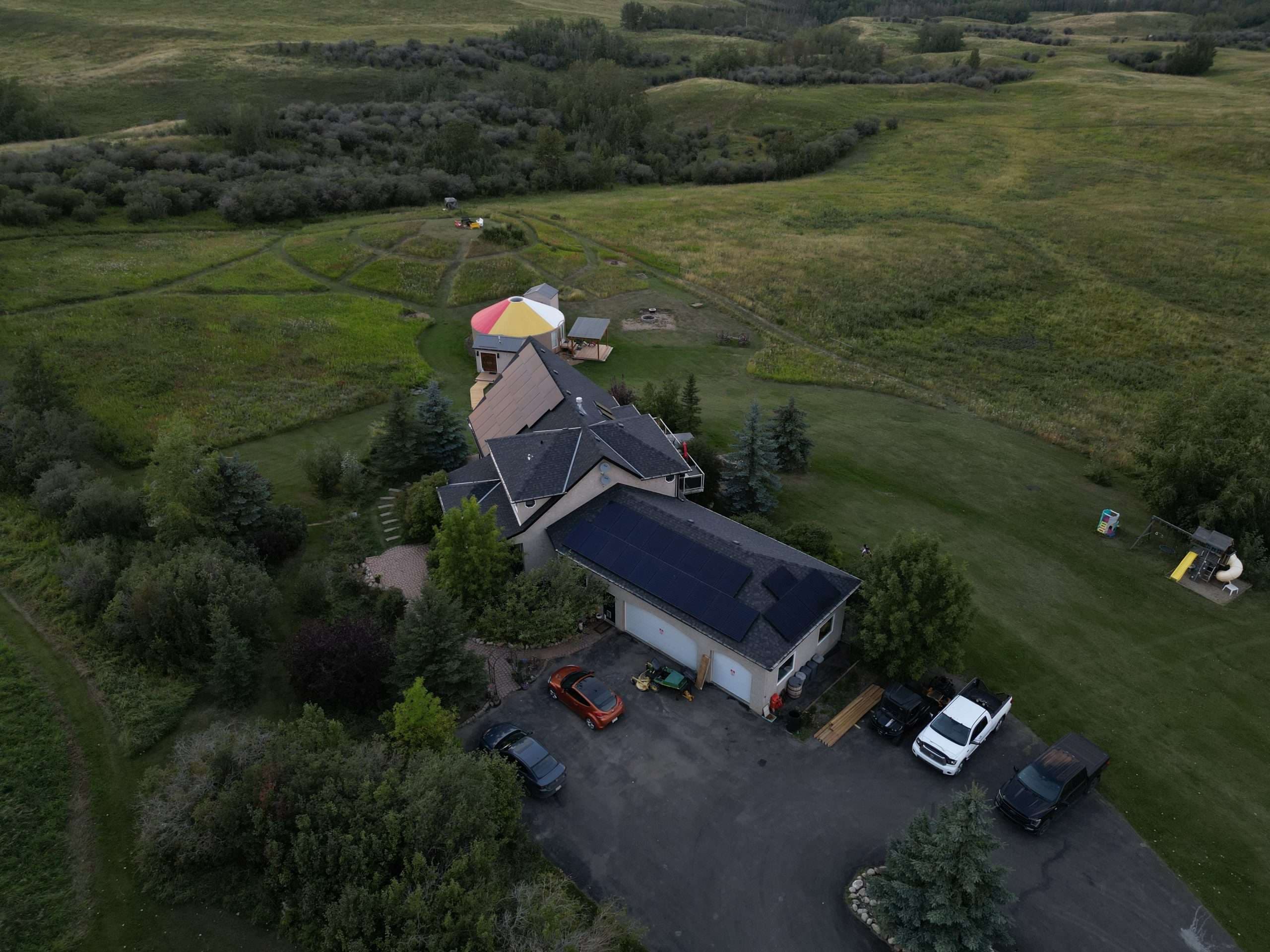
Flux Renewables is a Calgary-based solar and electrical contractor with 180+ completed installs across Alberta, including Banff. Banff sits 128 km west of Calgary in FortisAlberta distribution territory, so the economics of solar here look similar to Calgary's: but the details around financing, snow loads, and permitting are meaningfully different. This page walks through what applies specifically to a Banff install.
The Numbers for a Banff System
Alberta residential roofs deliver roughly 1,230 kWh per year for every kW-DC of panels installed at Banff's latitude, on an optimally-tilted south-facing plane. That means:
- A 6 kW system ≈ 7,400 kWh/year
- An 8 kW system ≈ 9,800 kWh/year
- A 10 kW system ≈ 12,300 kWh/year
At Alberta's current $0.35/kWh regulated microgeneration export rate, every surplus kWh exported back to the grid earns a credit on your utility bill. Most Banff homes we install run between 6 and 12 kW depending on annual consumption, roof area, and whether EVs or a heat pump are in the picture. Every system is backed by our 90% year-one production guarantee: if year-one production lands under 90% of our estimate, we pay you 12 cents per kWh on the shortfall.
A Calgary home running a credit balance
Eric Daniel is on our team, and his 9.09 kW system is our open book. Twelve straight months of statements, every one published as a PDF. Winter runs positive, summer runs the meter backwards.
See every billCEIP Financing in Banff
Banff is a participating municipality in the Alberta Clean Energy Improvement Program (CEIP), which lets homeowners install solar and other clean-energy upgrades with $0 down and repay the loan through their property tax bill. The current terms for Banff:
- 3% fixed interest rate
- Up to 20-year term, with no penalty for early repayment
- Minimum project: $7,500; maximum: $50,000
- Must be installed by a CEIP Qualified Contractor (Flux Renewables is on the directory)
- $9,000 rebate stacks on top of the financing
Banff runs a separate Solar Incentive Program: $450 per kW of installed capacity, up to a 20 kW cap ($9,000 max). Post-install cash rebate paid by the Town after your Microgeneration agreement with Fortis is finalized. Apply any time year-round. Program details →
Official Banff CEIP details: banff.ca/1364/Clean-Energy-Improvement-Program
Engineering Specifics for Banff
Banff’s ground-snow load is 3.6 kPa, over three times Calgary’s. Standard Alberta racking is under-spec’d here. We use mountain-rated rail and upgraded attachment spacing, and every Banff system gets a stamped structural review as part of the quote, not an optional add-on.
Banff sits inside Banff National Park, so residential solar projects on Parks Canada-leased properties also require compatibility review from Parks Canada. Flat-plate rooftop PV mounted flush to the existing roof is typically approved without heritage-panel scrutiny; ground-mount and pole-mount arrays face stricter aesthetic review.
Building and electrical permits in Banff are issued through Town of Banff Planning & Development (with Parks Canada review on federally-leased land). Flux handles the permit package, inspections, and utility microgeneration enrollment as part of the standard install, you do not touch the paperwork.
FortisAlberta Microgeneration in Banff
Banff sits in FortisAlberta distribution territory. Your solar system connects at the meter and feeds back through the same wires that deliver grid power today. You keep your existing electricity retailer (you can choose any Alberta retailer regardless of who delivers the electrons), and your $0.35/kWh microgeneration export credits appear on your retail bill. For a detailed walkthrough of how net billing works in Alberta, see how solar works.
What Our Banff Installs Include
- Tier 1 panels (500 W bifacial modules, default manufacturer set by current allocation and your roof layout)
- APSystems microinverters with panel-level monitoring
- Full-perimeter rodent guard (standard, not an upsell)
- Module-level shutdown inherent to microinverters (no separate rapid-shutdown device to buy or maintain), plus an AC disconnect at the meter
- Inverter loading ratio designed to 1.2–1.3 (see why)
- Panel replacement to a 225 A busbar if the existing busbar is maxed, quoted as a line item, not hidden
- 25-year panel performance warranty, 25-year APSystems inverter warranty, 5-year Flux workmanship, 1-year labour, and our 90% year-one production guarantee (we pay 12 cents per kWh on any shortfall below 90%)
Frequently Asked Questions about Solar in Banff
Does Flux install in Banff directly, or do you subcontract?
We send our own in-house crew to Banff. We do not subcontract residential installs. Flux is a Master Electrician-led company, which means every system is designed, permitted, and signed off by a Master Electrician before and after installation, even though the crew on your roof on install day is our own crew, not our founder personally. The advisor you meet, the designer who builds the system, and the crew who installs it all work for Flux.
How much more expensive is solar in Banff compared to Calgary?
128 km is outside our no-surcharge radius, so we add a modest travel and per-diem line item for Banffinstalls, typically $500 to $1,500 depending on system size. On an install that costs $15k–$30k, that is a 2–5% adder, and it is always quoted up-front.
Do I need a different racking system because of the snow load in Banff?
Yes. At 3.6 kPa ground snow, Banff's structural loading is well beyond what standard Alberta racking is rated for. We specify mountain-duty rail, reduce attachment spacing, and include a stamped structural review in every Banff quote. This is not a surcharge, it is the only honest way to design a system here.
Can I add a battery later in Banff?
Yes, and we design for it. The busbar headroom we leave at the 1.2–1.3 inverter loading ratio is what lets you add a battery (or a second solar string) later without replacing the panel a second time. See our guide on adding batteries or EV charging after solar.
Other Alberta Service Areas
We install across Alberta. Some of the cities we regularly work in:
- Solar in Calgary, 5.7% CEIP
- Solar in Edmonton, 6% CEIP
- Solar in Lethbridge, 2.83% CEIP
- Solar in Medicine Hat, no local CEIP
- Solar in Strathmore, no local CEIP
- Solar in High River, no local CEIP
- Solar in Airdrie, 2.75% CEIP
- Solar in Canmore, 2.7% CEIP
- Solar in Chestermere, no local CEIP
- Solar in Cochrane, no local CEIP
- Solar in Okotoks, 3% CEIP
- Solar in Langdon, no local CEIP
- Solar in Red Deer, no local CEIP
See your Banff roof modelled in 60 seconds
We pull satellite imagery, analyse your roof, and show you the numbers before you talk to anyone. No 8-question quiz. No email required to see results.
Start instant assessment