Solar Incentives
Solar incentives
in Alberta
Alberta offers some of the best solar incentives in Canada. Between export credits, tax benefits, and financing programs, the economics have never been stronger.
Alberta offers some of the best solar incentives in Canada. Between export credits, tax benefits, and financing programs, the economics have never been stronger.
Most Albertans do not realize that roughly 60% of their electricity bill goes toward delivery charges, transmission fees, rate riders, and administrative costs - not the actual electricity they consume.
Solar export credits can offset these non-energy charges too. When your system produces more than you use, the export credits accumulate and reduce your entire bill, including the fixed charges that most people assume are unavoidable.
Solar export credits can offset all categories, not just energy charges.
Alberta solar owners benefit from multiple incentive streams that stack together.
Under Alberta microgeneration regulations, surplus solar energy exported to the grid earns credits at the retail electricity rate - currently up to $0.35 per kWh. These credits offset your consumption charges, significantly reducing or eliminating your electricity bill.
Municipal programs and periodic provincial or federal grants can reduce your upfront cost. Availability varies by location and program cycle. We track current opportunities and help you apply.
Programs like CEIP let you finance solar through your property taxes with no upfront cost. Financeit offers fixed-rate installment loans. Both keep your capital free while your system pays for itself.
Businesses can access the 30% federal Investment Tax Credit and write off the full system cost in year one through accelerated Capital Cost Allowance. These dramatically shorten commercial payback periods.
From net billing credits to municipal rebates and property-tax financing, Alberta homeowners have multiple ways to reduce the cost of going solar.
Several Alberta municipalities pay cash rebates on top of CEIP financing. The most generous active program right now is the Town of Banff Solar Incentive Program — $450 per installed kilowatt, up to 20 kW ($9,000 max). Other municipalities run periodic programs with limited funding windows. We track active programs across the province and will let you know if your address qualifies.
Even without a direct rebate, the combination of net billing credits and financing programs makes solar economically compelling for most Alberta homeowners.
Two financing programs make it possible to install solar without any upfront capital.
The Clean Energy Improvement Program finances up to 100% of your solar project through your property taxes. Terms up to 25 years keep payments low, and the balance transfers with the property if you sell. Calgary has made CEIP permanent.
Learn about CEIP →Fixed monthly installment loans at a promotional 10.99% APR over 5 years with no markup on your sticker price; the financed amount equals the cash price. Instant approval, no prepayment penalties.
Learn about Financeit →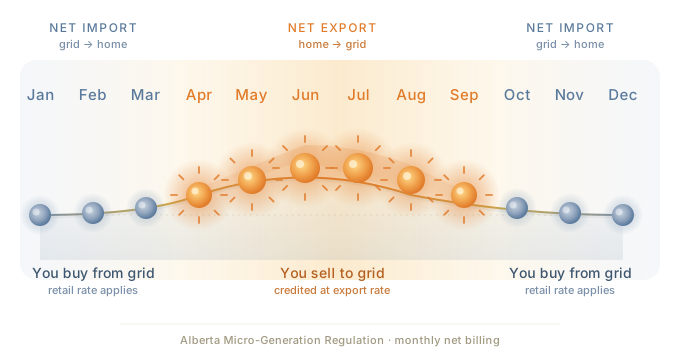
Alberta's microgeneration regulations allow residential solar system owners to export surplus electricity to the grid. You receive a credit on your utility bill at the current retail rate, which has reached up to $0.35 per kWh.
These credits offset not just your energy charges but also delivery, transmission, and administrative fees. For systems sized appropriately, net billing credits can reduce your annual electricity cost to near zero.
Alberta has no PST, meaning you only pay 5% GST on your solar installation. In provinces with HST, homeowners pay 13% to 15% in sales tax on the same system. This effectively gives Alberta homeowners an 8% to 10% cost advantage on solar compared to most of Canada.
We design your system to match your consumption pattern, maximizing self-use and export credits without over-building.
Use CEIP or Financeit to eliminate upfront costs, then let your net billing credits offset or exceed your financing payments.
Municipal rebates often have limited funding. We help you apply quickly when programs open to secure your rebate.
Installing in spring or early summer maximizes your first-year production and credits. We help you plan the optimal timeline.
As of 2026, there is no active provincial rebate program for residential solar in Alberta. However, municipal programs and federal financing options are available. We monitor all programs and will notify you when new incentives launch.
When your solar system produces more electricity than you consume, the surplus is exported to the grid. You receive a credit on your utility bill at the current retail rate, which can be up to $0.35 per kWh. Credits are applied against your entire bill, including delivery and transmission charges.
Yes. You can use CEIP or Financeit financing while also receiving net billing credits and any applicable municipal rebates. These incentives stack, and we help you capture every one you qualify for.
Alberta has no provincial sales tax (PST), so you only pay the 5% federal GST on your solar installation. This is a significant advantage compared to provinces with HST, where solar systems are subject to 13% or 15% sales tax.
CEIP is expanding to more Alberta municipalities. If your area does not participate yet, Financeit is available province-wide as an alternative financing option. You can also use a HELOC through your bank.
Stack the 30% federal ITC with accelerated CCA write-offs, net billing credits, and CEIP financing to dramatically shorten your payback period.
The federal ITC provides a 30% refundable tax credit on the cost of eligible clean energy property, including solar photovoltaic systems. For a $200,000 commercial solar installation, this means a $60,000 credit applied directly against your federal tax liability. The credit is refundable, meaning you receive the full value even if your tax owing is less than the credit amount.
Refundable - you receive the full value regardless of tax liability.
Solar energy equipment falls under Class 43.1 or 43.2 of the Capital Cost Allowance schedule, allowing businesses to write off the full cost of the system in the first year. Combined with the ITC, this dramatically reduces the effective cost of a commercial solar installation and shortens the payback period to as little as 4 years.
Write off 100% of the system cost in year one.
Commercial properties with solar systems under 5 MW qualify for Alberta microgeneration. Surplus electricity exported to the grid earns credits at the retail rate, currently up to $0.35 per kWh. For businesses with daytime operations, solar production closely matches peak consumption, maximizing self-use savings.
Credits offset delivery, transmission, and admin fees too.
Beyond export credits, generating your own electricity directly reduces the amount you purchase from the grid. For businesses with large daytime loads - manufacturing, warehousing, retail, offices - solar can offset 50% to 80% of electricity consumption during production hours.
Hedge against volatile electricity prices.
The Clean Energy Improvement Program is available for commercial properties in participating municipalities including Calgary. Finance up to 100% of your solar project through your property tax bill with terms up to 25 years. The balance stays with the property, making it attractive for properties you may sell or refinance.
No upfront capital required.
The real power of commercial solar incentives in Alberta is how they combine. The ITC reduces your upfront cost by 30%. The CCA lets you write off the remainder in year one. And net billing credits provide ongoing returns for 25+ years.
The result is a system that can pay for itself in as little as 3 to 4 years and generate returns for decades after. No other capital investment offers this combination of government support, predictable returns, and operational savings.
Illustrative example. Actual values depend on system size, location, electricity rates, and tax situation.
Calgary CEIP accepts commercial applications starting March 24, 2026. Finance up to 100% of your solar project through your property taxes with no upfront capital required. The balance transfers with the property, making it an attractive option for commercial landlords and property investors.
Any Canadian-Controlled Private Corporation (CCPC) or eligible business entity that installs qualifying clean energy equipment can claim the 30% ITC. This includes corporations, partnerships, and certain trusts. The equipment must be used primarily in Canada for the purpose of generating electricity from solar energy.
Yes. The ITC and CCA are separate incentives that stack. After claiming the 30% ITC, the remaining cost basis of the system is eligible for accelerated CCA, allowing you to write off the balance in year one. This combination can reduce the effective cost of your solar system by 50% or more.
Alberta microgeneration regulations apply to systems up to 5 MW. Most commercial rooftop systems fall well below this threshold. Systems above 5 MW may qualify as small power producers under different regulations.
CEIP for commercial properties works the same as residential - the cost is financed through your property taxes over up to 25 years. For commercial applications in Calgary, the 2026 intake opens March 24, 2026. The balance transfers with the property on sale.
With the ITC, CCA, and net billing credits combined, commercial solar systems in Alberta typically achieve payback in 4 to 6 years. Over a 25-year system life, the return on investment can exceed 300%, depending on system size, electricity rates, and consumption patterns.
Yes. A solar system reduces operating costs, which increases net operating income. For income-producing properties, this directly translates to higher property valuations. The system also signals environmental responsibility, which is increasingly valued by tenants and customers.
Type your address. We’ll show your roof, your savings, and which incentives apply, in 60 seconds.